
FPGA Distributor for AI Edge Builds: What to Check in 2026
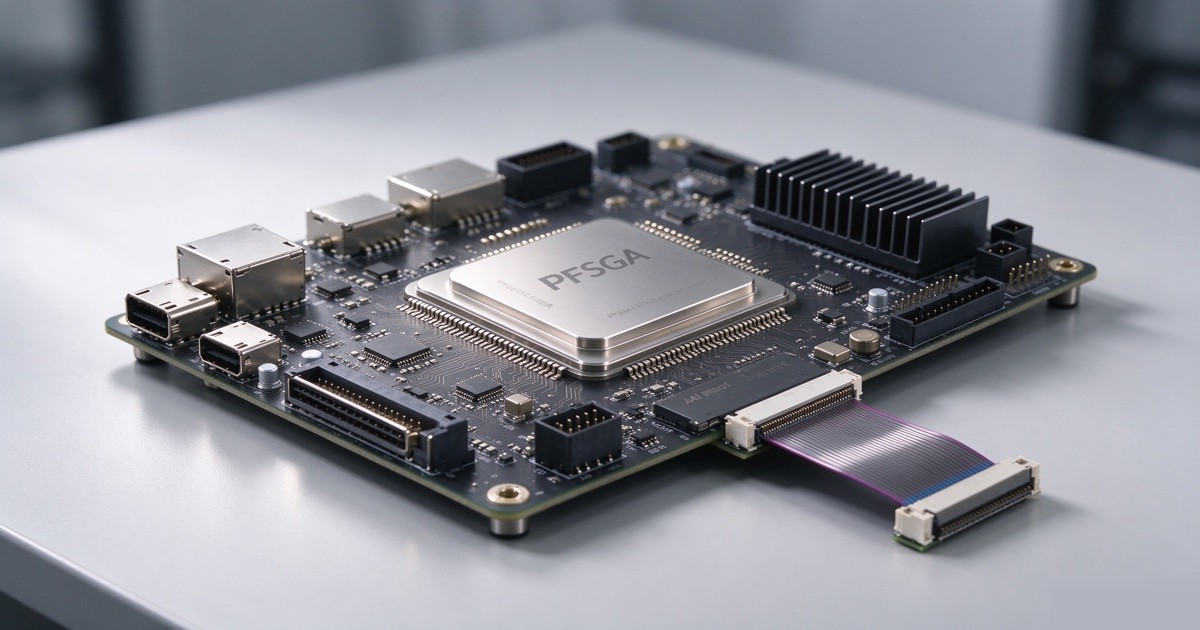
An FPGA distributor is a component supplier that sources field-programmable gate arrays from manufacturers such as AMD (Xilinx), Intel (Altera), Lattice, and Microchip — either through franchised channels with factory authorization or independently from the open market. Because FPGAs carry some of the longest lead times and highest counterfeit rates in the industry, the distributor you pick matters more than the part number on your BOM. Getting this decision wrong can stall a production line for months.
That warning lands harder in 2026 than it did two years ago. Demand from AI edge inference, industrial vision, and defense programs has pulled FPGA supply tight in specific families, and the open market is flooded with remarked and pulled parts as a result. This guide walks through what actually matters when you qualify a distributor — and where buyers most often get burned.
Why FPGA sourcing is different from buying MCUs or passives
FPGAs are high-value, low-volume compared to commodity parts. A single Kintex-7 or Cyclone V device can run $80 to $400, and large Virtex or Agilex parts cross four figures. That price point makes them a prime target for counterfeiters — a $300 chip is worth sanding, remarking, and reselling in ways a $0.40 capacitor is not.
There's a second wrinkle: lifecycle. FPGA families stay in production for 15 to 20 years, so a design frozen in 2012 may still need Spartan-6 or Cyclone IV parts that franchised channels no longer stock in volume. Buyers end up on the open market whether they like it or not. The question becomes how to do it safely.
The current supply environment adds pressure. As Semiconductor Engineering's recent chip industry review notes, AI compute demand is tightening supply chains across equipment and critical materials, and that pressure cascades into programmable logic allocation. When wafer capacity gets prioritized for AI accelerators, mid-range FPGA families feel it first.
Common FPGA families and what to expect on lead times
Lead times swing hard by family and speed grade. Here's what buyers are realistically seeing in late 2026, based on distributor quotes and broker market behavior — treat these as planning figures, not guarantees.
| Family (Vendor) | Typical Use | Example Part | Package | Franchised Lead Time | Open Market Risk |
|---|---|---|---|---|---|
| Spartan-7 (AMD) | Cost-sensitive I/O, bridging | XC7S50-2FGGA484I | FBGA-484 | 20–30 weeks | Moderate |
| Artix-7 (AMD) | Machine vision, comms | XC7A100T-2FGG676I | FBGA-676 | 26–40 weeks | High |
| Cyclone V (Intel) | Industrial control | 5CEFA7F23I7N | FBGA-484 | 16–26 weeks | Moderate |
| ECP5 (Lattice) | Edge AI, display bridging | LFE5U-45F-6BG381C | caBGA-381 | 12–20 weeks | Low–moderate |
| PolarFire (Microchip) | Low-power, defense | MPF300T-FCG484I | FCBGA-484 | 20–32 weeks | Moderate |
| Spartan-6 (AMD, mature) | Legacy industrial | XC6SLX45-2CSG324I | CSBGA-324 | Allocation / limited | Very high |
Two things jump out from that table. First, anything older than about 2015 is effectively an open-market purchase now. Second, the industrial-temperature (-I) grade parts carry longer lead times than commercial grade, because fabs prioritize volume commercial SKUs. If your design can tolerate commercial grade with derating, say so on the RFQ — it can cut ten weeks off a wait.
What to actually check when vetting an FPGA distributor
Skip the glossy website checklist. These are the things that separate a reliable supplier from a problem:
- Lot and date code traceability. Ask for photos of the actual reels or trays before payment, with readable labels. A legitimate distributor sends them within a day. Stalling or sending generic stock photos is a red flag.
- Country of origin and chain of custody. For franchised stock, ask for the C of C from the manufacturer. For open-market stock, ask where the lot came from — factory excess, OEM overstock, or a broker chain. Three hands or more between the factory and you means degraded traceability.
- Moisture sensitivity handling. Most BGA FPGAs are MSL 3 or 4. Trays that sat open in a warehouse for two years need baking before reflow. Ask for MSL exposure history. Few buyers do; most regret it when yield drops at assembly.
- Test capability. Can they do X-ray, decapsulation sampling, or at minimum solderability and marking permanency tests (MIL-STD-883 methods) on request? For open-market buys over $10k, third-party lab verification pays for itself the first time it catches a remarked lot.
- MOQ flexibility. Franchised channels often enforce full-reel or tray MOQs. A good independent distributor will split trays for prototype quantities — important when you need 25 pieces of a $200 part, not 250.
One more: ask how they handle a failed-lot claim. A distributor with a written RMA process and a real answer beats one offering a vague "we stand behind our parts." Get it in the quote terms.
Franchised vs. independent: the honest trade-off
Franchised distribution gives you guaranteed provenance and factory warranty, but you get their allocation, their MOQ, and their lead time. During allocation periods, small and mid-size buyers get pushed to the back of the queue — that's just how it works.
Independent distributors fill the gaps: short-lead stock, obsolete families, broken lot sizes. The trade-off is verification burden shifts to you. The sensible approach most procurement teams land on is hybrid — franchised for new production ramp volume, a vetted independent for shortages, legacy parts, and spot buys. XingHuan International works this side of the market, stocking hard-to-find and allocated FPGA families with lot-level documentation, which is where independents earn their keep.
Don't frame it as franchised good, independent risky. Frame it as: who owns the verification cost? With franchised stock the factory does. On the open market, you do — so budget for it.
The AI edge angle: why 2026 buyers should plan earlier
Edge AI is pulling FPGAs into sockets that used to be pure MCU territory — vision preprocessing, sensor fusion, low-latency inference offload. EE News Europe's coverage of embedded world North America 2026 highlighted how far edge AI has moved into embedded designs, and that trend feeds FPGA demand at the low and mid range: Lattice ECP5 and CertusPro, AMD Artix and Zynq-7000, Intel Cyclone parts.
Practical implication: if your 2027 product roadmap includes an FPGA anywhere near the BOM, lock in quotes and, where possible, place scheduled orders now. Spot-buying FPGAs during an allocation cycle means paying 2–4x franchised price on the open market, with verification costs on top.
A realistic scenario we've seen repeatedly: a buyer needs 300 pieces of an Artix-7 for a vision product, franchised quote says 36 weeks. Open market has stock at 1.8x price. They buy, skip third-party testing to save $1,500, and discover at assembly that 15% of the lot fails boundary scan. Total loss: weeks of schedule plus rework. The testing would have caught it in five days.
Counterfeit red flags specific to FPGAs
FPGA counterfeits follow patterns. Know them:
- Blacktopping and remarking. Commercial grade remarked as industrial (-C to -I), or slower speed grade remarked as faster. Acetone swab on the marking reveals blacktopping; X-ray shows die size mismatches.
- Pulled parts sold as new. Desoldered BGAs get re-balled and trayed. Look for solder residue in the tray pockets, inconsistent ball sheen, or flux residue around package edges.
- Empty package scams. Rare but real on high-value parts — genuine package, dummy or missing die. X-ray or a quick JTAG IDCODE read catches this. Any distributor unwilling to support pre-shipment sample testing on a large order deserves suspicion.
Date code consistency matters too. A reel claiming 2023 date codes with a label format the manufacturer retired in 2021 tells you something before you spend a dollar on lab work.
FAQ
Q: What is the difference between a franchised and independent FPGA distributor?
A: A franchised FPGA distributor holds factory authorization from AMD, Intel, Lattice, or Microchip and sells with full manufacturer warranty and traceability. An independent distributor sources from the open market — useful for obsolete parts, shortages, and small quantities, but you carry the verification burden and typically get a distributor warranty rather than a factory one.
Q: How can I tell if an FPGA lot is counterfeit before buying?
A: Start with paperwork: demand reel photos, C of C, and lot chain history before payment. Then verify physically — marking permanency (acetone test), X-ray for die and wire bond consistency, and a JTAG IDCODE read on samples. For orders above roughly $10k, a third-party lab screening at $500–$1,500 is cheap insurance.
Q: What lead times should I plan for FPGAs in 2026?
A: Budget 16–40 weeks from franchised channels depending on family, with industrial-temperature grades at the long end. Mature families like Spartan-6 are effectively allocation-only and usually require open-market sourcing. If your build is schedule-critical, place scheduled orders 9–12 months out or secure vetted spot stock early.